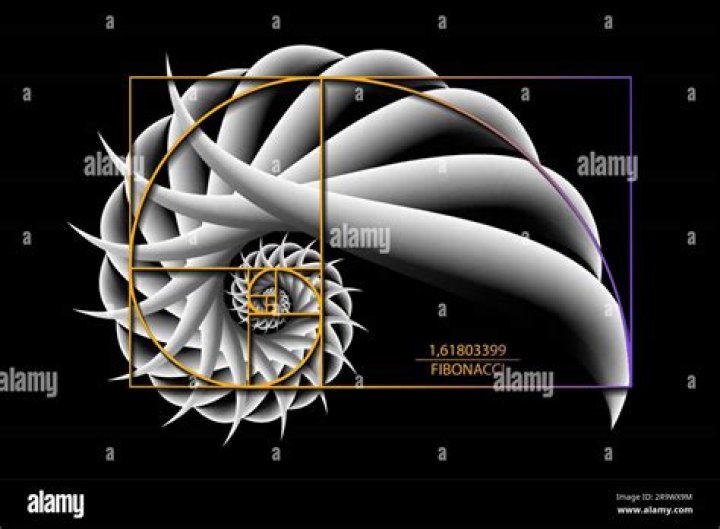
Is the golden ratio related to fractals?
 Amelia Brooks
 Inspired by the golden ratio, mathematician Edmund Harriss discovered a delightful fractal curve that no one had ever drawn before. But it’s not just a pretty picture, it contains some lovely theory – and brings the golden ratio into a family of perfect proportions.
How is the golden ratio represented in nature?
The golden ratio is about 1.618, and represented by the Greek letter phi, Φ. The golden ratio is sometimes called the “divine proportion,” because of its frequency in the natural world. The number of petals on a flower, for instance, will often be a Fibonacci number.
Do fractal patterns exist in nature?
Fractal patterns are extremely familiar, since nature is full of fractals. For instance: trees, rivers, coastlines, mountains, clouds, seashells, hurricanes, etc. Abstract fractals – such as the Mandelbrot Set – can be generated by a computer calculating a simple equation over and over.
How is the Fibonacci sequence related to fractals?
The Fibonacci Spiral, which is my key aesthetic focus of this project, is a simple logarithmic spiral based upon Fibonacci numbers, and the golden ratio, Φ. Because this spiral is logarithmic, the curve appears the same at every scale, and can thus be considered fractal.
What is the golden spiral in nature?
This shape, a rectangle in which the ratio of the sides a/b is equal to the golden mean (phi), can result in a nesting process that can be repeated into infinity — and which takes on the form of a spiral. It’s call the logarithmic spiral, and it abounds in nature.
Is butterfly fractal?
The Hofstadter butterfly is a fractal pattern—it contains shapes that repeat on smaller and smaller size scales. In fact, the Hofstadter butterfly is one of the first quantum fractals theoretically discovered in physics but, until now, there has been no direct experimental proof of this spectrum.
Why is the golden ratio important in nature?
The Golden Ratio is a mathematical ratio. It is commonly found in nature, and when used in a design, it fosters organic and natural-looking compositions that are aesthetically pleasing to the eye.
What are the 5 patterns in nature How is Fibonacci related to nature?
Another simple example in which it is possible to find the Fibonacci sequence in nature is given by the number of petals of flowers. Most have three (like lilies and irises), five (parnassia, rose hips) or eight (cosmea), 13 (some daisies), 21 (chicory), 34, 55 or 89 (asteraceae).
How are fractals seen in nature?
Some of the most common examples of Fractals in nature would include branches of trees, animal circulatory systems, snowflakes, lightning and electricity, plants and leaves, geographic terrain and river systems, clouds, crystals.
Why are fractals found in nature?
Fractals are hyper-efficient and allow plants to maximize their exposure to sunlight and cardiovascular systems to most efficiently transport oxygen to all parts of the body. Fractals are beautiful wherever they pop up, so there’s plenty of examples to share.
Why does nature use Fibonacci?
The Fibonacci sequence in nature The Fibonacci sequence, for example, plays a vital role in phyllotaxis, which studies the arrangement of leaves, branches, flowers or seeds in plants, with the main aim of highlighting the existence of regular patterns.
How do you identify fractals in nature?
A fractal is a kind of pattern that we observe often in nature and in art. As Ben Weiss explains, “whenever you observe a series of patterns repeating over and over again, at many different scales, and where any small part resembles the whole, that’s a fractal.”
How is the golden ratio related to fractals?
It’s not so much that the golden ratio is “related to fractals,” as fractal patterns can be based on any number. Fractal patterns created using the golden ratio, however, are optimized in a way that does not occur with any other number.
How do you explain the golden ratio?
Key Takeaways The golden ratio describes predictable patterns on everything from atoms to huge stars in the sky. The ratio is derived from something called the Fibonacci sequence, named after its Italian founder, Leonardo Fibonacci. Nature uses this ratio to maintain balance, and the financial markets seem to as well.
What is the golden section ratio?
The Golden Section is a ratio based on a the number Phi, 1.618…. The Golden Section or Ratio is is a ratio or proportion defined by the number Phi (= 1.618033988749895… ) It can be derived with a number of geometric constructions, each of which divides a line segment at the unique point where:
What is the golden ratio in geometry?
Golden Ratio. The golden ratio (symbol is the Greek letter “phi” shown at left) is a special number approximately equal to 1.618. It appears many times in geometry, art, architecture and other areas.


