What is the vesicles formed during pinocytosis?
 Rachel Hickman
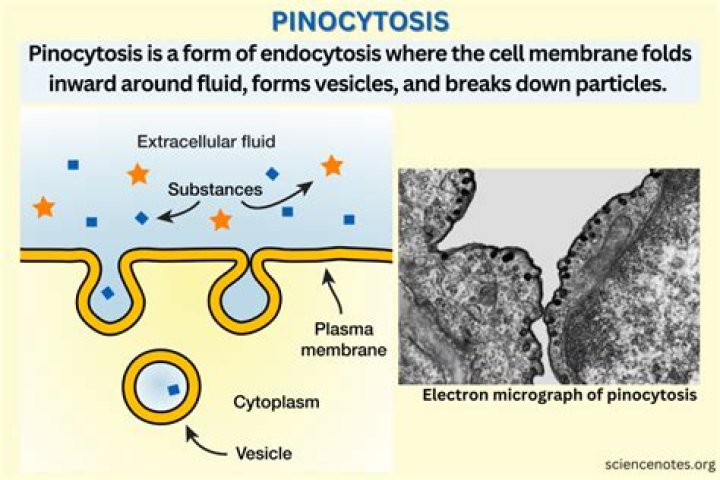
 In pinocytosis, rather than an individual droplet of liquid traveling passively through the cell membrane, the droplet first becomes bound, or adsorbed, on the cell membrane, which then invaginates (forms a pocket) and pinches off to form a vesicle in the cytoplasm.
What is the function of Pinocytic vesicle?
The pinocytotic vesicles function as carriers of the extracellular fluid into the cell.
What is the formation of vesicles?
In cell biology, a vesicle is a structure within or outside a cell, consisting of liquid or cytoplasm enclosed by a lipid bilayer. Vesicles form naturally during the processes of secretion (exocytosis), uptake (endocytosis) and transport of materials within the plasma membrane.
What is the mechanism of pinocytosis?
A mechanism for pinocytosis is suggested which relates adsorption of charged solutes on the plasmalemma to a decrease in the tension and the structural rigidity of the membrane. The weakened membrane is drawn down into the cytoplasm by its “points of attachment” to the contractile plasmagel system.
What is pinocytosis in cell membrane?
In cellular biology, pinocytosis, otherwise known as fluid endocytosis and bulk-phase pinocytosis, is a mode of endocytosis in which small particles suspended in extracellular fluid are brought into the cell through an invagination of the cell membrane, resulting in a suspension of the particles within a small vesicle …
What is absorptive pinocytosis?
Pinocytosis is a form of endocytosis involving fluids containing small solutes. In humans this process occurs in cells lining the small intestine and is used primarily for absorption of fat droplets. Pinocytosis, a type of endocytosis.
Why do vesicles move around the cytoplasm?
Because vesicles are made of phospholipids, they can break off of and fuse with other membraneous material. This allows them to serve as small transport containers, moving substances around the cell and to the cell membrane.
Is pinocytosis a form of osmosis?
Osmosis is to transport water molecules down water potential gradient. Endocytosis is to transport big molecules inside the cell. When it is a droplet of solution that is taken inside the cell the process is called pinocytosis, like the case of Euglena engulfing a droplet from the pond to take the food in it.
Is pinocytosis receptor mediated?
Pinocytosis is variably subdivided into categories depending on molecular mechanism and the fate of the internalized molecules. Pinocytosis is, in some cases, considered to be a constitutive process, while in others it is receptor-mediated and highly regulated.
What is the function of the vesicles in pinocytosis?
These vesicles transport extracellular fluid and dissolved molecules (salts, sugars, etc.) across cells or deposit them in the cytoplasm. Pinocytosis, sometimes referred to as fluid-phase endocytosis, is a continual process that occurs in most cells and a non-specific means of internalizing fluid and dissolved nutrients.
What is the difference between pinocytosis and cell drinking?
It also refers as “ Cell drinking ” or “ Fluid phase endocytosis ” that does not occur in a particular or specialized type of cell. Thus, pinocytosis merely refers as the cellular process that brings the extracellular fluid along with the solutes from cell surrounding into a cell cytosol.
Does pinocytosis only occur in eukaryotes?
It prevalently occurs in eukaryotes. Pinocytosis, cell drinking or fluid-phase endocytosis does not occur in a particular or specialized type of cell. Thus, pinocytosis merely refers to the cellular process that brings the extracellular fluid along with the solutes from cell surrounding into a cell cytosol.
How do vesicles move from the membrane to the cytoplasm?
In some cells, long channels also form extending from the membrane deep into the cytoplasm. Fusion of the ends of the in-folded membrane cuts the vesicle off from the membrane, allowing the vesicle to drift towards the center of the cell.